
Monday, February 23, 2026
You're afraid of what failing would say about you.

The question you don't ask out loud
You're building something. People around you are on board. You talk about your customers with confidence, who they are, what they need, why this matters to them.
And most of the time, you believe it.
But every now and then, usually when it's quiet, usually when there's nobody else in the room, something surfaces.
Do I actually know these people? Or am I just really good at sounding like I do?
You don't sit with it long. There's always something else to do.
But it comes back.
The part nobody talks about
Here's the thing about being a founder with a track record.
People expect you to know. Your team, your investors, the people who joined because they believed in your judgment. You've been the one in the room saying: I know who this is for. I know what they want. Trust me.
And you meant it. You weren't making it up.
But there's a difference between believing something and actually knowing it.
Romano Pravdic runs multiple companies at the same time. Different markets, different teams, different levels of risk. He put it plainly:
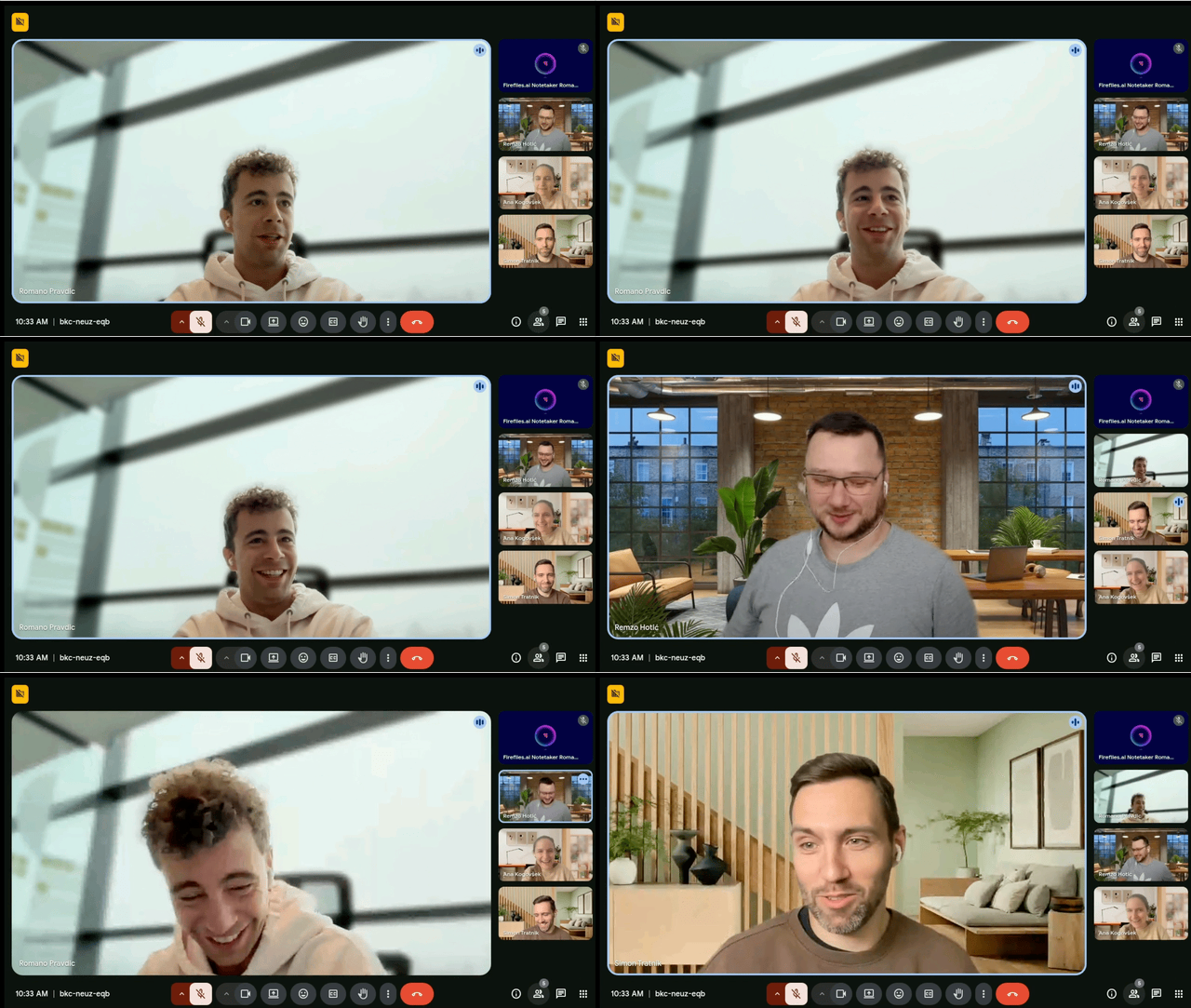
"I'm constantly juggling multiple ideas with very different expectations and stakes."
— Romano Pravdic
Stakes. That word does a lot of work.
Because when the stakes are real — real money, real people counting on you, real reputation — the gap between what you assume about your customer and what's actually true starts to feel dangerous.
Not in a way you'd admit to anyone.
In the way you feel it alone on the drive home.
The fear isn't really about the product not working. It's about everyone finding out that your confidence was always a bit ahead of your actual knowledge. That you were convincing — including to yourself — about something you never fully verified.
Why it's hard to just go find out
You'd think the obvious move is to go talk to customers. Run some interviews. Get the data.
But most founders don't. Not really. Not in a way that's actually designed to challenge what they already believe.
Because doing it properly means accepting that you might get an answer you don't want.
And that answer wouldn't just mean changing your roadmap.
If I got this wrong. Not because of bad timing, not bad luck. But because I didn't actually understand who I was building for... what does that mean about me?
That's the real question underneath. Not 'is my product right.' But 'is my judgment worth trusting.'
You've built your whole approach to this work on the belief that you can read people, spot problems, understand markets. That's the bet you placed when you decided to do this.
So you keep moving. You ship. You tell yourself you'll learn from what happens.
Which is true. But it's also a way of not having to find out yet.
What Romano found when he actually looked
Romano had a banking idea he wanted to test. Real stakes: money, reputation, the kind of project where being wrong has consequences.
He went in not to confirm what he thought. To find out what he didn't know.
What came back wasn't a big yes. It was something more useful:
"I got a clear feeling of: okay, I'm aiming in the right direction. I'm onto something."
— Romano Pravdic
That's it. That's the thing.
Not certainty. Just clarity. The feeling of someone who actually checked, and came back with a real answer instead of a guess dressed up as confidence.
He also found out which customer segments were worth his time, and which ones weren't. That second part is underrated. Knowing who to stop thinking about is its own kind of relief.
And then something he didn't see coming:
"Wow, I got positioning angles that I didn't think of."
— Romano Pravdic
This is what happens when you actually listen instead of confirm. The people you're building for show you things you couldn't have found on your own. Not because you're not smart, because you're too close. Your assumptions have a shape, and you've been looking through them so long you stopped noticing.
Real customer language does something else too. Romano said it simply:
"The messaging hooks helped me speak their language. And that matters."
— Romano Pravdic
When you use the exact words your customers use to describe their own problem, something shifts. It stops sounding like a pitch. It sounds like you understand them. Because you do.
What changes after
The question quiets down.
Not because everything is figured out, nothing ever is. But because you're not carrying an unanswered question anymore. You asked it. You got a real answer. You adjusted.
That's a different kind of confidence than the one you were performing before. It's not louder. It's just solid.
You stop dreading the moment someone asks you to get specific about your customer. Because you can.
Romano came back from that process knowing where to focus, what to say, and who to say it to. Not because HolyShift gave him a magic answer. Because he finally stopped avoiding the question.
That part was on him.
It usually is.
If you're sitting on that question right now
You know if you are.
HolyShift is where founders go to actually ask it, and come back with real direction, real customer language, and a clearer picture of who they're building for.
What... STILL NOT SURE?
What Are You Waiting For?
You can spend the next 6 months guessing… or you can find out exactly what works in days.
Follow us on Social

HolyShift © 2025. All Rights Reserved.

What... STILL NOT SURE?
What Are You Waiting For?
You can spend the next 6 months guessing… or you can find out exactly what works in days.
Follow us on Social
Copyright © HolyShift 2025. All Rights Reserved.